Wireless Energy
for All Devices.
Everywhere
We are changing the way devices are designed and use energy.
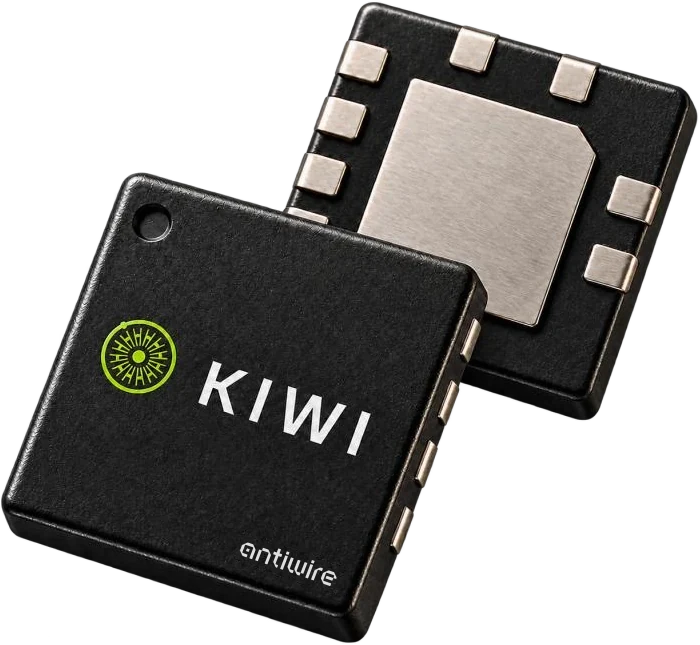
Our technology turns the energy available in the environment — electromagnetic fields, light and motion — into stable, regulated electricity to power electronic devices.
Our chips make it possible to build devices that run without cables, without chargers and, in many applications, without ever replacing a battery.
More than power-management chips, a new approach: capture, convert and reuse the energy that already exists around us.
Proven at scale
- 100+
- Companies running Antiwire today
- Thousands
- Devices already built with our technology
- 200,000+
- Batteries avoided in five years
- 8
- Patents granted
- 22
- Patents in development
Batteries avoided is our own estimate over the last five years of deployment.
What our technology does
Ambient energy in. Regulated power out.
Our chips capture three kinds of energy that are already present wherever a device lives — the electromagnetic field around any powered equipment, light and motion — store what they collect and deliver a regulated supply to your load. Continuously, with no cable and no charger.
What sets us apart: beyond the conventional sources, our patented technology also captures the reactive energy present in the environment — the electromagnetic noise that surrounds every powered machine, cable and panel, around the clock, indoors or in the dark. Energy is therefore always available, and it is converted with high efficiency.
The chip manages the whole path — harvesting, storage and delivery — so your load always sees a stable, regulated supply.
Electromagnetic field
Around every motor, drive, panel, luminaire and energised cable, there whenever the equipment is on — day and night, indoors, or even inside an enclosure. An available energy that no other chip harvests. That is why KIWI works where solar and RF harvesters do not.
Light
From a dim cabinet interior to direct sun. The boost path is sized for the real range of indoor and outdoor light, and contributes whenever there is any.
Motion
Vibration, a press, a pulse. Enough energy is extracted from the event itself for a switch, a remote or a lock to power its own action — no battery in the loop.
Whichever is there
The sources rarely fail together: a running machine radiates and vibrates while the lights above it are off. KIWI captures from whichever source is present, and the supply to your device stays stable.
What changes in your product?
The battery is a design problem: it decides the size, the shape and the life of a product. Take it out of the way, and the design is free.
No battery to replace — or no battery at all
The chip keeps a small cell topped up for the life of the device. Where the ambient energy covers the load, the cell goes and a capacitor takes its place — no battery hatch, no charging port, a smaller, sealed product.
Hundreds of thousands of batteries have already been avoided with Antiwire technology — and this is only the beginning.
No cable, so the device goes wherever it makes the most sense
Sensors on motors, tags on assets, locks on doors, switches on walls, luminaires on poles — placed by what the application needs, not by the nearest outlet.
No wiring, no conduit, no electrician.
Energy recycled, batteries avoided
The device runs on energy the installation already produces and would otherwise be lost. Fewer cells bought, replaced and discarded; no charger, no cable, less copper.
A lower product carbon footprint to report — and, increasingly, less regulation to carry (see below).
Incentives for products built on national technology
In Brazil, products that embed nationally developed technology can qualify for tax-incentive programmes such as the Lei de Informática and the PPB, with reduced taxes on the finished product.
Our chips are conceived, patented and engineered in Brazil, and we help you document the national-technology content for the application.
Less battery, less regulation to carry
Battery rules are tightening in every market we sell into. A product with no battery to replace — or no battery at all — sidesteps most of it.
Battery Regulation 2023/1542
Portable batteries in products must be removable and replaceable by the user from 18 February 2027, and producers pay for the collection and recycling of every battery they place on the market.
No battery: no redesign, no fee.
Producer-funded battery take-back
State by state — Illinois from 2026, Washington from 2027, California and D.C. with programmes of their own — alongside right-to-repair laws.
Fewer batteries in the field means fewer programmes to register in and fund.
A smaller carbon footprint to report
Energy that is harvested rather than bought lowers the product's carbon footprint, which buyers now ask for in Scope 3 reporting, green public procurement and eco-label applications.