The product
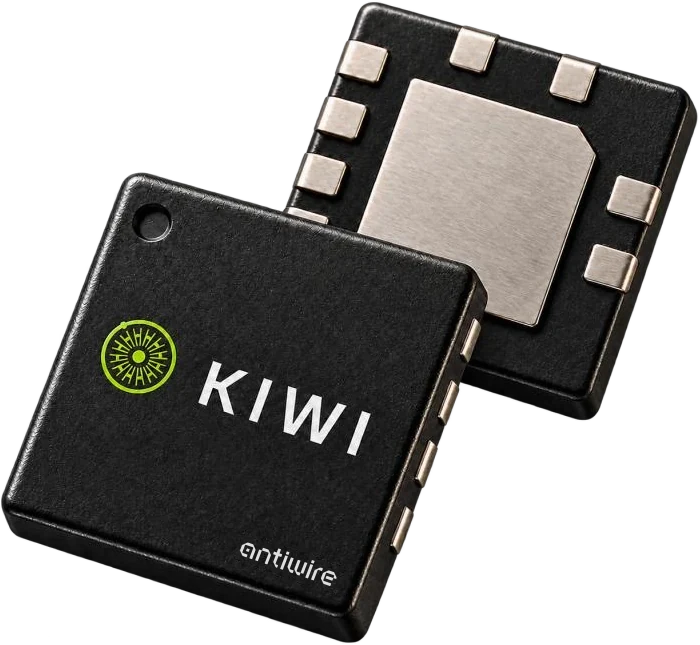
KIWI ONE®
Multi-source energy-harvesting IC: electromagnetic field, light and motion in one chip, delivering a regulated supply to your load. Radio-agnostic, placed on the host PCB like any other component.
It takes the exact position previously held by the voltage regulator in front of the battery — and changes what that position does. It harvests, it charges the cell, which becomes a buffer rather than a fuel tank, and it regulates the output to the load. The rest of your schematic is unchanged, and no RF expertise is required of your design team.
- Continuous DC
- 200 µW – 15 mW
- Input band
- 50 Hz – 150 MHz
- Output rail
- 1.5 – 5.0 V
- Output current
- 100 mA
- Cold start
- 1 µA · 300 µV
- Quiescent
- 500 nA
- Efficiency
- 85 % · 92 % pk
- Package
- QFN 10 × 10 × 3
It replaces the regulator, not the design
Three energy domains, one managed power path
An energy-aware state machine holds the policy for cold start, load enable and load shed, so your MCU is not woken only to discover there is not enough energy to do anything useful. Storage-agnostic. Radio-agnostic — BLE, LoRa, Sub-GHz or Wi-Fi.
Datasheet figures
| Parameter | Typ | Range |
|---|---|---|
| Continuous DC delivered | — | 200 µW – 15 mW |
| Harvesting input frequency | — | 50 Hz – 150 MHz |
| Regulated output voltage | — | 1.5 – 5.0 V |
| Output current | — | up to 100 mA |
| End-to-end efficiency | 85 % | 92 % peak |
| Quiescent current, output enabled | 500 nA | 900 nA max |
| Shutdown current, ship mode | 15 nA | 50 nA max |
| Package | QFN, 8 pads + EP · 10.0 × 10.0 × 3.0 mm | |
| Parameter | Min | Typ | Max | Unit |
|---|---|---|---|---|
| Harvesting input frequency, EH_IN1–4 | 50 | — | 150 M | Hz |
| Input voltage after cold start | 0.05 | — | 5.0 | V |
| Cold-start input current | 1 | — | — | µA |
| Cold-start input voltage | 300 | — | — | µV |
| Storage element voltage, VSTOR+ | 0 | — | 5.5 | V |
| Continuous DC power delivered | 200 µ | — | 15 m | W |
| Regulated output, VDC_OUT | 1.5 | — | 5.0 | V |
| Ambient temperature, TA | −20 | 25 | 85 | °C |
| Parameter | Min | Typ | Max | Unit |
|---|---|---|---|---|
| Delivered DC power, PDC | 200 µ | — | 15 m | W |
| Cold-start input voltage, VSTOR = 0 V | — | 300 | — | µV |
| Cold-start input current, VSTOR = 0 V | — | 1 | — | µA |
| Quiescent current, IQ | — | 500 | 900 | nA |
| Quiescent current, sleep | — | 350 | 700 | nA |
| Shutdown current, ship mode | — | 15 | 50 | nA |
| End-to-end conversion efficiency | — | 85 | — | % |
| Peak conversion efficiency | — | 92 | — | % |
| Output current, VDC_OUT | — | 100 | — | mA |
| Output voltage accuracy, IOUT = 1 mA | −2 | — | +2 | % |
| Storage charge current, VSTOR | — | 100 | — | mA |
| Over-charge threshold, Li | 3.0 | 4.2 | 5.5 | V |
| Over-discharge threshold | 1.8 | 2.8 | 3.6 | V |
| Load-enable threshold, rising VSTOR | — | 1.9 | — | V |
Peak current and peak power available to the load are governed principally by the selected storage element, not by the IC. Size the capacitor, supercapacitor or cell for the peak demand of the application, and the harvesting budget for its average demand.
Advance information: design targets, to be replaced by measured MIN/TYP/MAX data in the production datasheet.
Functional pinout
Eight signal pads plus the exposed pad. Click a pad for its function. The device has no discrete ground pin — the exposed pad is the electrical reference, and VSTOR− and VDC_OUT− are the storage and load returns.
Reactive-field antenna port, first terminal. Connects to the Antiwire™ antenna.
Design resources
What we can put in your engineers' hands. The peer-reviewed papers are public; the device documentation is released under NDA while the part is at advance-information status.
KIWI ONE® datasheet
Absolute maximum and recommended operating conditions, electrical characteristics, thermal data, pin functions, typical application circuit, layout and installation guidance.
Architecture white paper
A multi-source power management IC for the reactive near field: adaptive front end, multi-source fusion and arbitration, and the energy-aware state machine.
Core technology white paper
Why a fixed matching network cannot reach this source, and what tracking the source impedance actually requires of the front end.
Experimental formulation to estimate the power density in the near field of a linear transmitting antenna
L. F. Destro and B. Galvão — 2021 IEEE Joint EMC/SI/PI and EMC Europe Symposium, pp. 413–416. The measurement method behind the chip.
Indoor harvesting RF energy system applied to low-consumption wireless devices
L. F. Destro and B. Galvão — IEEE ARGENCON 2020.
KIWI ONE® is at advance-information status. The production datasheet is released when qualification completes. Supply is as a device, or as a licence and co-development of the technology.